Why Repeating a Skill Is Not the Same as Learning It
Why repeating a skill is not the same as learning it: give each practice attempt a purpose and use clear feedback to make useful adjustments.
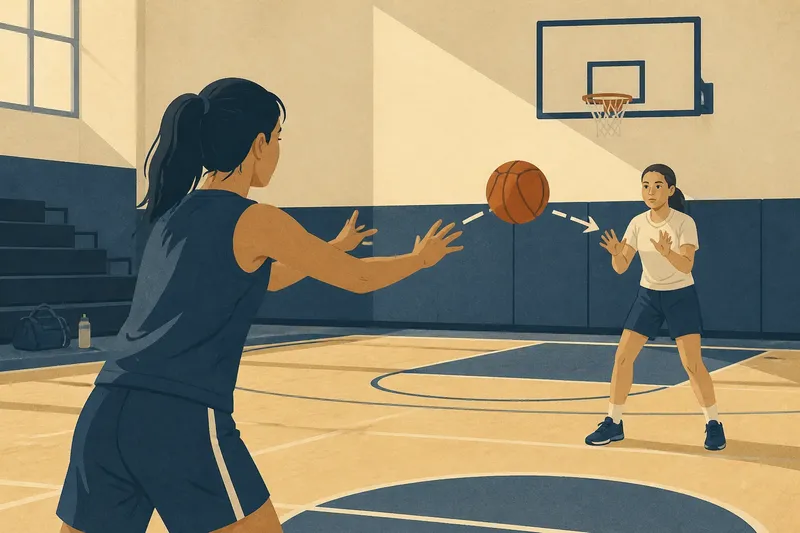
Why repeating a skill is not the same as learning it becomes clear when a basketball player keeps missing the same pass. Repetition can make a movement familiar, but learning asks for something more: a clear intention before the attempt and useful feedback afterward. The difference is not about training harder. It is about making each turn informative.
Imagine Maya, a fictional recreational basketball player who wants to improve her chest pass. During open gym, she throws pass after pass toward a partner. Some arrive too high, some drift wide, and a few land neatly in the partner’s hands. She is getting plenty of repetitions, but the results vary without a clear pattern. When practice ends, she cannot say what changed or what she should try next.
Her situation offers a useful walk-through. The aim is not to prescribe one perfect technique for every player, but to show how an intention and a moment of feedback can turn an ordinary drill into focused practice.
The familiar drill
Maya’s first instinct is to count successful passes and keep going until she feels tired. She stands several paces from her partner and throws the ball back and forth. The partner catches most of them, but sometimes steps aside to reach one. Maya notices the catch, yet she does not know whether her pass was aimed poorly, released late, or simply difficult to receive.
This is a common trap in skill practice: the visible action can continue while attention wanders. A player might repeat a tennis serve, a soccer touch, or a volleyball set while thinking only about getting through the drill. Familiarity grows, but the same small error can travel from attempt to attempt without being noticed.
Imagine Maya decides to change one thing before the next pass. Rather than trying to “throw better” in general, she chooses a specific intention: send the ball toward the space between her partner’s chest and hands. That gives her a target she can picture and her partner can observe. The pass still requires coordination, but the attempt now has a question attached to it: did the ball reach that space?
One clear intention
A useful intention is narrow enough to guide attention and broad enough to let the body move naturally. “Make a perfect pass” is hard to act on because perfection does not identify what to notice. “Aim for the receiver’s chest” gives Maya a concrete focus without dictating every joint position or turning the drill into a list of body parts.
For another skill, a recreational tennis player might choose to send the ball over the middle of the net with a comfortable arc. A beginner at soccer might focus on cushioning a rolling pass so the ball stays close enough for the next touch. These intentions point toward an observable result. They do not require the player to monitor every movement at once.
Maya also makes the drill easier to read. She and her partner agree to stay in place, use a comfortable pace, and pause briefly after each small group of passes. If the partner has to reach, that is not automatically a failure; it is information. A pass near the intended target gives Maya a reason to keep the current approach, while a consistently high or wide path gives her a reason to adjust one feature.
Think of practice like writing with a pencil rather than stamping the same mark again and again. The pencil lets you notice a line, make a small correction, and try the next one with that change in mind. The point is not to erase every imperfect attempt. It is to make the next attempt more deliberate.
Feedback that helps
Feedback is useful when it helps answer the question Maya set. Her partner can say, “That one reached my chest,” or “That one came above my hands.” Those remarks describe what happened. A vague “good job” may be friendly, but it does not tell Maya which part of the target she reached or what to attend to next.
Players can also use their own observations. Maya notices whether the ball’s path matched her intention, and she can listen for whether her partner caught it without moving. A phone recording may help with a visible skill when everyone involved is comfortable being recorded, but it is optional; a simple verbal cue is often enough. More feedback is not always better. A stream of comments about aim, grip, stance, and release can leave a player trying to change everything in one turn.
Suppose Maya’s first focused group of passes repeatedly arrives high. She chooses one adjustment for the next group: finish with her hands directed toward the target rather than lifting them away. After that group, she checks the same outcome. If the ball now arrives closer to the intended space, she can keep the adjustment for another round. If it does not, she can return to a comfortable motion and choose a different, small question rather than piling on corrections.
That sequence matters: intention, attempt, observation, adjustment. The order gives feedback a job. Without a prior intention, a comment can become a random tip. Without observation, an adjustment is just a guess.
Changing the practice
Once Maya can send a controlled pass to a stationary partner, she can alter the task. Her partner might take a small step to either side before receiving, or Maya might pass after catching a return ball. The change adds a decision while preserving the original focus: aim for a reachable receiving space. If the task becomes so difficult that every pass is rushed and unpredictable, she can simplify it again.
This is not a rule that every drill must become harder. A player may need to return to a stationary target to regain a feel for the movement. A change in distance, pace, or direction is useful only if the player can still pay attention to the chosen intention. Treat each adjustment as a question, not a badge of progress.
Maya keeps the practice human, too. She and her partner alternate throwing and catching, and they take a short pause when concentration slips. The drill is meant to help her enjoy basketball, not turn a casual gym session into an examination. A useful practice can be focused and relaxed at the same time.
How does focused practice work?
How many repetitions should I do?
Stop when attention fades or the chosen task no longer gives useful information. A smaller set of attentive attempts can be more helpful than continuing mechanically, and the right amount depends on the player, skill, and session.
Should I fix every mistake?
No. Pick one feature connected to the intention, such as where the pass arrives, and leave other details alone for now. Trying to correct several things at once makes it harder to tell what affected the result.
Is feedback from a partner enough?
Often, yes, especially when the partner can describe a clear outcome without piling on technique advice. The player’s own view of the result matters too; use video only when it is suitable, wanted, and permitted in that setting.
What if the skill gets worse?
Make the task simpler and return to a comfortable pace. A rough stretch can mean the challenge is too high, attention has wandered, or the chosen cue is not useful; it does not automatically mean the player has lost the skill.
The result she can use
Imagine Maya finishes her session able to say that her passes were more often reaching the intended space when she aimed at her partner’s chest and checked the result after each group. That is an observable outcome for this invented situation, not a promise that the same cue suits every player. She has also learned how to make her next practice question: keep the pass comfortable, change one feature, and see what happens.
When you next practice a sport skill, write or say a short intention before the first attempt. Choose feedback that directly answers it, then make one adjustment you can notice. The search phrase “why repeating a skill is not the same as learning it” points to a practical distinction: repetition supplies attempts; attention and feedback help those attempts teach you something.
If practice starts to feel like a test, return to a partner, a manageable target, and a pace that leaves room to think. The best sign of a useful session may be simple: you can describe what you were trying, what you noticed, and what you would like to explore next time.