The Myth of the One Correct Way to Celebrate a Point
Learn how to celebrate a point in sport with respect by reading the team, setting and moment instead of copying a custom that may not fit.
How should you celebrate a point without making the moment awkward? The answer depends on the team, the setting and the people involved—not on one universal rule. A quick fist pump may feel natural in one match and conspicuous in another. Before copying a celebration, take a moment to read the room.
Pause before joining
When a point ends, your first job is to notice what is happening around you. Is your team gathering, offering a quiet nod, or already turning to reset? Is the point part of a friendly rally, a close match, or a practice drill? Those details shape what will feel considerate.
This pause need not look stiff or calculated. Let your reaction be simple while you take in the moment: smile, make eye contact with a teammate, or offer a small nod. If others are already celebrating, you can join in without rushing to choose the loudest gesture.
Think of a celebration like a greeting at someone else’s home: the warm intention matters, but you still notice how people there greet one another. The same gesture does not suit every room, and it need not be copied to show that you care.
Read the setting
A point in a casual game with friends can invite laughter and playful energy. A point in a league match may call for a more contained reaction, especially if opponents are close by. In a lesson or drill, the useful response may be a brief acknowledgment followed by attention to the next repetition.
Also notice the setting’s practical demands. In a crowded court or field, an exuberant movement could distract someone nearby or get in the way of the next play. If the game is underway again quickly, keep your celebration short enough to return your attention to the action.
- Look at the score and the pace of the game: is the point a routine exchange or a turning moment?
- Notice whether teammates are facing one another or already preparing for the next play.
- Check how close opponents and other participants are before moving toward anyone.
- Watch whether the group is keeping celebrations quiet, playful, or visibly energetic.
These are clues, not a code everyone must follow. If you cannot tell what fits, a restrained reaction leaves room to respond more warmly once you understand the group.
Take your cue from teammates
Teams develop habits through repeated play, but those habits vary. One group may gather for a quick high-five after every point; another may save its energy for a set-changing rally. A player who joins a team for the first time can watch a few exchanges before deciding how to participate.
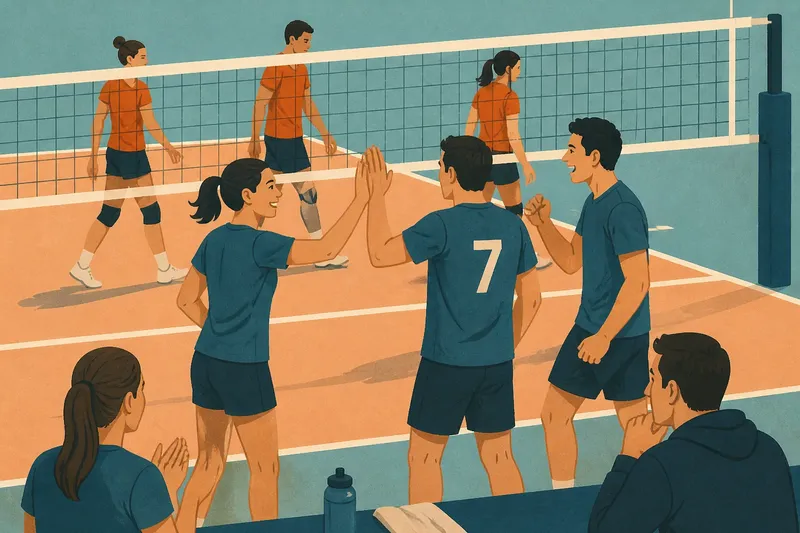
Say you join a recreational volleyball game where the players usually touch hands briefly after a point, then rotate into position. You notice the pattern after a rally, offer a quick high-five to the nearby players, and move to your next spot. The expected result is a clear, low-key sign of involvement that does not delay play or require you to imitate a more elaborate ritual.
Keep the gesture accessible to the people around you. A teammate may prefer a nod, may not be within reach, or may be focused on the next serve. A celebration does not need physical contact to communicate shared excitement; a smile or a short “nice point” can work just as well.
Choose a fitting response
Once you have read the setting and your teammates, choose a response that matches both your own comfort and the moment. You are not required to perform a big reaction to prove that you care. A genuine, modest gesture is often easier for others to read than a copied routine that feels out of place.
Useful options include:
- A nod or smile when the group is focused and the point needs little ceremony.
- A brief verbal acknowledgment such as “well played” when teammates or opponents made a good exchange.
- A quick high-five when teammates are already gathering and contact is welcome.
- A short fist pump when your team is visibly energized and the moment suits it.
- A quiet reset when the point is over and attention needs to return to play.
Consider who the celebration recognizes. If a teammate made a strong play, share the credit rather than making the reaction solely about yourself. If an opponent made an excellent shot, acknowledging it can show respect without taking anything away from your own team’s point.
Check the response
After you react, notice how others respond. Teammates may join you, return a greeting, or move straight on. Opponents may smile, look away, or appear unsettled. Treat those signals as useful information rather than as a verdict on your character.
If a gesture seems to land poorly, let it end and return your attention to the game. Avoid insisting that others join in or repeating a celebration to draw a reaction. If you have interrupted play or made someone uncomfortable, a simple apology is usually more helpful than a long explanation.
Personal style matters, too. Some players express excitement with movement; others prefer a quiet smile. Neither style automatically signals a lack of respect or a lack of enthusiasm. The practical question is whether your reaction leaves other people room to enjoy the point and continue playing.
Questions about point celebrations?
Should I copy the other team’s celebration?
Not by default. Notice whether it is an open, shared gesture or a team-specific ritual, then choose a response that fits your own side and the tone of the match.
Is a loud celebration disrespectful?
Not necessarily; volume can fit an energetic team or a meaningful moment. It is more likely to feel disrespectful if it is directed at an opponent to mock or provoke them.
What if I do not know the team’s custom?
Start with a smile, nod, or brief acknowledgment and watch what teammates do after the next point. You can also ask a teammate during a break what the group prefers.
Can I celebrate an opponent’s good play?
Yes, a sincere “nice shot” or nod can recognize skill while respecting the competition. Keep your attention on the game so the acknowledgment does not disrupt the next exchange.
Keep the moment shared
A point belongs to the game, but its celebration can include everyone who made the exchange worthwhile. Credit a teammate, recognize a fine play from across the net, and leave room for different ways of showing excitement. If you are unsure, a modest gesture gives you time to learn the group’s style without imposing your own.
That is the useful answer to how to celebrate a point in sport: respond to what is actually happening, not to a supposed universal custom. When your reaction fits the people and the moment, it can be warm, personal, and respectful without needing to look like anyone else’s.