Before the First Session: A Routine for Settling In
A settling-in routine for recreational practice helps you arrive calmly, check the session plan, and choose one manageable aim before play begins.
What should you do in the few minutes before recreational practice starts, especially when you arrive carrying the day with you? A settling-in routine gives you a small, repeatable way to shift attention toward the session: notice where you are, check what is planned, and choose one manageable aim. It need not be elaborate. A few calm decisions can make the opening feel less rushed without turning practice into another performance to judge.
Arrive with room
If you can, give yourself a little space between getting to the venue and joining the activity. That might mean walking from the parking area at an unhurried pace, putting your bag beside the court, or taking a moment near the edge of the field. The point is not to arrive early for its own sake. It is to avoid stepping directly from a phone call, commute, or hurried change into a drill while your attention is still elsewhere.
Choose a familiar place to put your belongings so you are not searching for a water bottle or jacket as the group gathers. Keep pathways clear and follow the venue’s usual arrangement for bags and personal items. A predictable place for your things works a little like a tray by the door at home: it removes one small decision when your mind is already moving toward practice.
On arrival, take in the immediate setting. Notice whether the group is still gathering, whether a coach or organizer is speaking, and where participants are expected to wait. These simple observations tell you how to join without interrupting. If you are new, a quiet “Where should I leave my bag?” or “Are we meeting by the far court?” is often enough to orient yourself.
Check the session plan
Before warming up or joining a group activity, find out what the session will involve. The plan may be written on a board, sent in a team message, or explained by the person leading practice. Listen for the broad shape rather than trying to memorize every detail: perhaps there is a warm-up, a skill activity, and a short game. Knowing the order helps you understand what is happening without needing to anticipate every instruction.
Look for practical details that affect your preparation. Is the group using one court or moving between areas? Will participants rotate partners? Is there a particular ball, racket, or other shared item to collect? If the plan is unclear, ask a brief question before the activity gets underway. That is usually easier than guessing and then having to leave a drill to find out.
Be ready for the plan to change. A space may be unavailable, attendance may be different than expected, or the group leader may adjust an activity. Treat the plan as a useful orientation, not a promise that every segment will happen exactly as announced. You can stay settled by paying attention to the next instruction rather than trying to solve the whole session in advance.
Choose one aim
Set one small intention for the session, phrased as something you can notice yourself doing. “Keep my eyes on the ball as it approaches” is more useful than “play better,” because it points to an action rather than an overall judgment. A recreational session can hold plenty of surprises; a manageable aim gives you one steady point of attention without asking you to control the outcome.
Keep the aim modest enough to remember during play. You might decide to call “mine” clearly when you take a ball, stay balanced before serving, or reset your position after a shot. Pick an action that fits the planned activity and your current energy. If you have had a demanding day, your aim might simply be to join each drill attentively and take breaks when needed.
Say the aim to yourself in a short phrase, then let it rest. Repeating it constantly can become another distraction. You are not making a contract to perform perfectly; you are choosing a useful cue that can bring your attention back when it wanders.
What should you check before practice?
What if I arrive late?
Join at a natural pause rather than walking across an active drill, and give the leader a quick, quiet greeting. Ask what you need to know to enter safely and understand the current activity; you can catch up on anything else after the session.
What if I do not know the plan?
Ask the coach, organizer, or a nearby teammate what the group is doing first. A simple question such as “Where should I start?” gives you an immediate next action without requiring a long explanation.
What if I feel distracted?
Notice the distraction without scolding yourself, then return to one concrete detail: the ball in your hand, the boundary line, or the next instruction. If you need a moment, step out of the activity when appropriate and rejoin when ready.
Should my aim be about winning?
It can be, if that suits the session, but a process aim is often easier to use during recreational practice. Choose an action you can attempt regardless of the score, such as communicating clearly or moving back into position.
Prepare without rushing
Use the time before activity to gather what you need, not to squeeze in extra effort. Put on the clothing and footwear appropriate to the surface, secure loose items, and have water accessible if the venue permits it. If a coach has specific instructions about equipment or participation, follow them; equipment labels, manufacturer directions, and local venue rules can differ.
Leave enough attention for the warm-up the group actually provides. Some sessions begin with shared movement; others expect participants to start with an easy individual warm-up. Follow the organizer’s direction rather than launching into a separate routine that might interfere with the group. If you are unsure, ask where and when to begin.
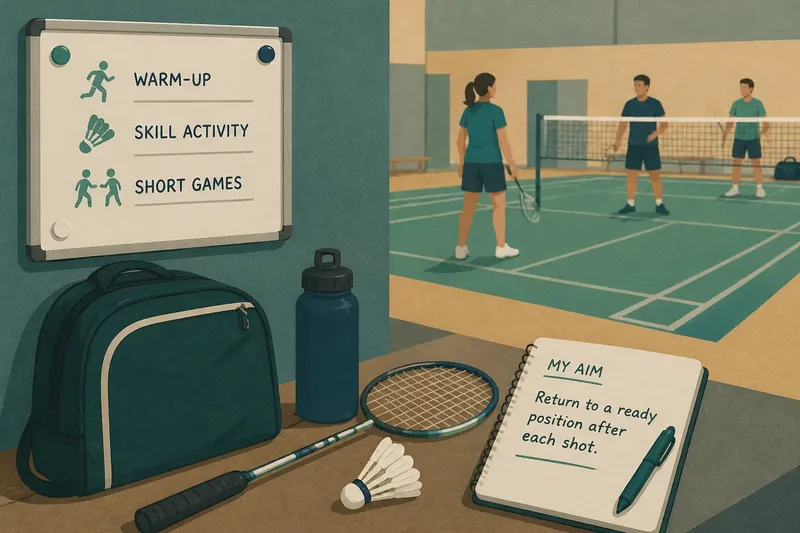
Imagine you arrive at a community badminton session after a busy afternoon. You place your bag against the designated wall, check the board, and learn that the group will begin with court movement before playing short games. You choose “return to a ready position after each shot” as your aim. When the first game starts, you have a clear cue to attend to, and you are not still wondering where the group is headed.
Make space for others
A settled arrival helps the group, too. Keep your greeting warm and brief if the leader is giving instructions, make room for people already preparing, and avoid claiming a spot or piece of shared equipment before you know how it will be used. These gestures are small, but they help the session begin without unnecessary confusion.
If you are a regular participant, notice whether someone seems unsure where to go. Offer a short pointer—“We’re gathering by the benches”—then let them settle in. There is no need to explain the whole club or session before practice begins. A useful welcome gives a new person a clear next step and leaves the organizer free to lead.
Once activity starts, let your chosen aim guide your attention without turning it into a scorecard. If you forget it, return to it at the next pause. If the session changes direction, choose a new cue that fits what the group is doing. The routine is working when it helps you become present, not when every part happens exactly as planned.
Before your next recreational session, try keeping the sequence simple: arrive, orient yourself, check the plan, and choose one action to notice. The best settling-in routine is one you can use on an ordinary day, even when you have little time or your mind is busy. Let it end when practice begins; the session itself is where you get to participate.